Headcount shows how many people are employed, not how much work they can deliver. Overtime, unplanned absences, rework and gaps in shift coverage can all push workforce costs up while headcount stays flat.
All insightsHuman Capital ROI
Your Headcount Hasn’t Changed. So Why Are Workforce Costs Rising?
Overtime is up but headcount is flat. Learn how to connect finance, HR and operations data to see what’s really driving workforce costs before you cut or hire.
11 November 2026 · 5 min read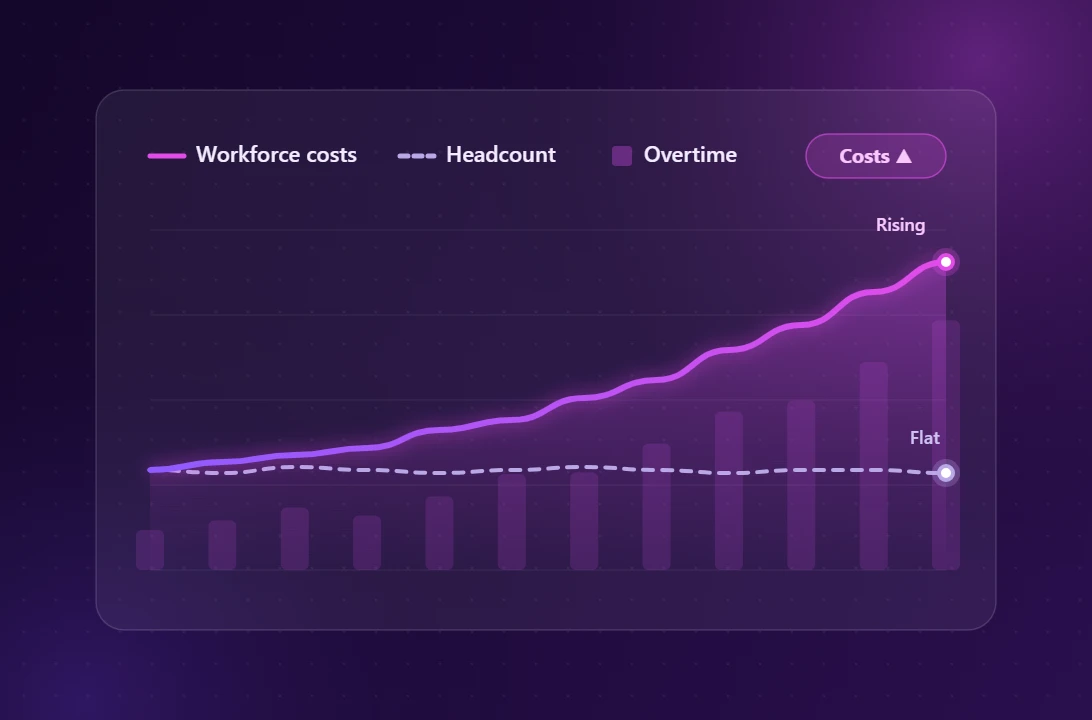
It’s Monday morning. The CFO opens the latest financial report and spots a familiar problem. Headcount is stable. Salaries haven’t changed significantly. Yet workforce costs have gone up again.
Overtime is the first line that stands out. The obvious move is to ask department heads to cut it. But before anyone sets a new limit, there’s a question worth asking: What work is that overtime covering?
The answer might be in a shift schedule, an absence report or an operations dashboard. Finance can see the extra spend. HR can see where absences have increased. Operations can see where output has slipped. Put those three views together and the same expense can point to a very different decision.
Why stable headcount can hide rising workforce costs
Imagine two departments report a similar increase in overtime. In the first, demand rose for a few weeks and the team worked extra hours to clear the backlog. In the second, demand stayed flat, but unplanned absences increased and fewer jobs were completed during normal hours.
Both departments show the same budget problem. The first may need a better plan for predictable peaks. The second needs a closer look at shift coverage and how work is allocated. A company-wide overtime cap would treat both situations the same way, even though the teams are solving different problems.
This is also why stable headcount can be misleading. A headcount figure tells you how many people are employed. It doesn’t tell you how many experienced people were available on a particular shift, whether they were assigned to the work that needed them most or how much time went into redoing a task. Those differences can change the cost of delivering the same amount of work, which is why measuring human capital ROI takes more than tracking salaries.
Finance, HR and operations: three pieces of the same workforce cost story
One reason workforce costs are hard to explain is that each department measures something different. Finance tracks what was spent. HR tracks changes in the workforce. Operations tracks what the business delivered. Each report can be accurate on its own and still leave leadership with an incomplete explanation, a gap we explore in the hidden cost of disconnected data.
Take a team where overtime rose over the past month. Finance can identify the increase and the cost centre. HR may see that absences rose during the same period. Operations may see that output fell on certain shifts. The useful next step is to check whether those changes happened in the same team, on the same shifts and in the same weeks.
If they line up, the COO can ask a focused question: were extra hours needed to cover absences, clear a backlog or compensate for another disruption? If they don’t line up, the team can check other explanations, such as a change in order volume or a process bottleneck. As with most performance problems, the cause is rarely where you look first. Either way, leadership has a clearer starting point for the conversation with the people closest to the work.
How VAI helps leaders investigate rising workforce costs
VAI’s Cross-Disciplinary Intelligence connects HR, finance and operational data so leaders can examine spending, workforce behaviour and performance together. It’s one way workforce intelligence differs from HR analytics.
Suppose a CFO wants to understand why overtime is rising while headcount remains flat. VAI can help surface where higher overtime spend coincides with increased absence and lower productivity. That gives the CFO and COO a specific pattern to investigate with the relevant team, rather than asking every department to explain its numbers from scratch.
The pattern is a lead. The team still needs to check what happened on the ground. Were certain shifts harder to cover? Did work pile up after a handover? Were experienced employees pulled away to train new starters? Those details determine whether the right response is to adjust coverage, change the process or make a case for additional capacity.
Questions to ask before cutting overtime or approving a hire
Where is the extra spend concentrated? Check whether it’s spread across the business or clustered in a particular team, location or shift. What changed at the same time? Compare the increase with absences, workload and output over the same period. Check when each change began. What would happen if we removed the extra hours? Find out whether the work could be absorbed during normal hours or whether a cut would leave orders, shifts or customer requests uncovered. That last question matters as much when considering a hire. If demand has grown and the team is consistently short of capacity, an additional role may make sense. If delays are concentrated at one handover, hiring could add cost while leaving the delay in place. And if overtime is covering a temporary spike, a change to scheduling may be enough.
The same financial report can support several decisions. What separates them is the evidence behind the cost.
Bring a better question to your next workforce cost review
When the next report shows workforce costs rising again, start with the largest increase and ask what changed in that part of the business. Bring finance, HR and operations into the same conversation while the details are still fresh. If the team agrees on what to investigate, it can test a targeted change and see whether costs improve without putting service or output under pressure.
Discover how VAI connects workforce, finance and operational data so you can investigate what’s driving costs before you decide what to change. Book a demo to see it with your own data.
Key takeaways
- Stable headcount can hide rising workforce costs driven by overtime, unplanned absences and lost productivity.
- The same overtime increase can need different fixes: better planning for predictable peaks in one team, better shift coverage in another.
- Finance, HR and operations each see part of the story. Lining up their data by team, shift and week shows what is really driving the cost.
- Before cutting overtime or approving a hire, check where the spend is concentrated, what changed at the same time and what removing the extra hours would leave uncovered.
Frequently asked questions
Not before you know what the overtime is covering. A blanket cap treats a temporary demand spike and an absence-driven coverage gap the same way, and can leave orders, shifts or customer requests uncovered.
Finance shows where spend increased, HR shows workforce changes such as absences, and operations shows changes in output. Checking whether those changes happened in the same team, on the same shifts and in the same weeks points leaders to the real cause.
VAI’s Cross-Disciplinary Intelligence connects HR, finance and operational data, so leaders can see where higher overtime spend coincides with increased absence and lower productivity, then investigate that pattern with the relevant team.
See these ideas running on your own data.Book a demo
More insights
The Executive Guide to Human Capital ROI
Read article
The $10 Million Question Every CEO Should Be Asking Their Workforce Data
Read article