Beyond General-Purpose AI
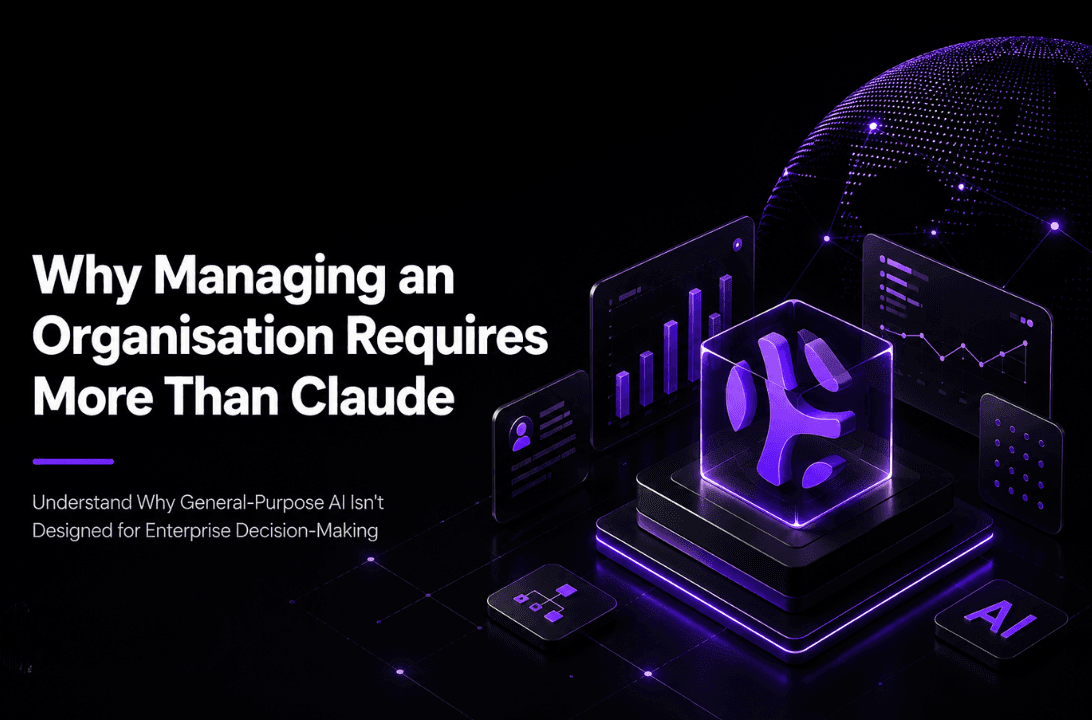
Across every industry, organisations are giving employees access to generative AI and seeing exactly what they expected: faster task completion, higher-quality outputs, immediate access to information.
Which leads to an understandable assumption. If artificial intelligence can improve the productivity of every employee, surely it can improve the performance of the organisation itself.
Organisational performance, though, is rarely determined by productivity alone. It is determined by whether employees trust their managers, whether accountability exists at every level, whether behavioural patterns get recognised before they become operational problems, and whether culture supports execution or quietly prevents it.
Imagine two organisations. Both give every employee access to Claude. Both see similar improvements in document quality, research capability and administrative efficiency. Six months later one has stronger execution, higher engagement and better leadership, while the other still has declining morale, inconsistent management and poor strategic execution.
The difference is not the AI. The difference is what each organisation understands about itself.
This whitepaper examines what we call the Enterprise AI Illusion, why productivity metrics measure activity rather than effectiveness, and why behaviour changes first while business performance changes later. It sets out the case for a behavioural layer that connects people to operational performance, and why the future of executive decision-making will depend less on model sophistication than on understanding the behavioural drivers behind organisational success.
Organisations rarely fail through a lack of information. They fail because they do not recognise behavioural patterns early enough to change the outcome.